How the Sabarimala Reference is Being Used to Shut the Doors of Public Interest Litigation
By Annanya Mishra

“If a person who is not a devotee and has nothing to do with the temple challenges it, can this Court hear such a writ petition?”
— Justice B.V. Nagarathna, Sabarimala Reference Hearing, April 8, 2026
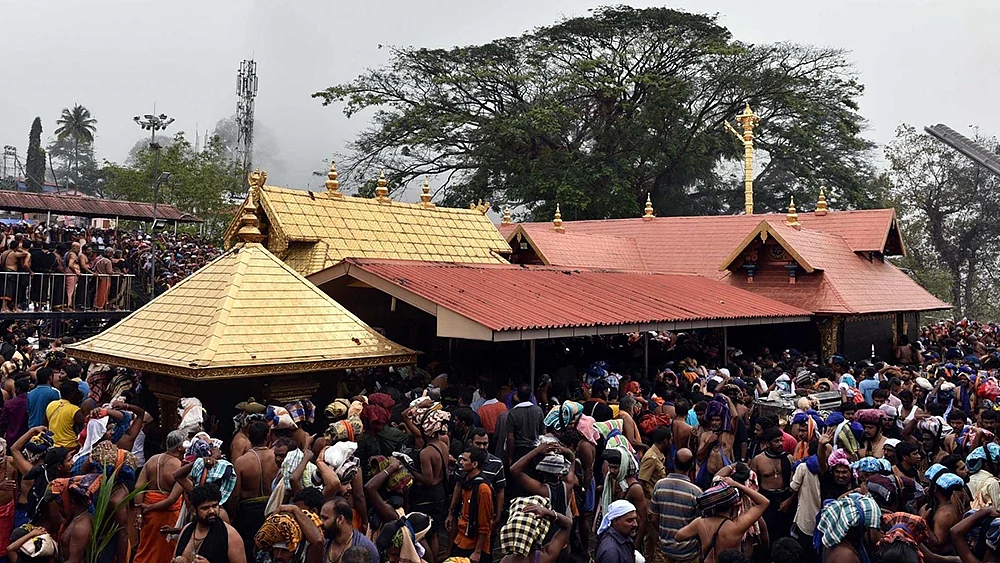
New Delhi | There is something quietly audacious happening inside the Supreme Court of India this month. A nine judge Constitution Bench, assembled to settle the smouldering question of whether women between the ages of ten and fifty may enter the Sabarimala temple in Kerala, has become the site of a far larger argument one that concerns not the sanctity of Lord Ayyappa’s shrine, but the sanctity of the citizen’s right to knock on the courthouse door. The Solicitor General of India, appearing for the Union government before this historic bench, has urged the Court to do something remarkable: to end Public Interest Litigation as a jurisdictional exception altogether. This editorial argues that such a step would not be a reform. It would be a regression. One that borrows the language of judicial discipline to accomplish something far more consequential: the removal of the principal mechanism through which India’s marginalised have accessed constitutional justice for four decades.
- The Case That Became Two Cases
The Sabarimala reference began, formally, in 2018, when a five-judge bench of the Supreme Court voted four to one to strike down the centuries old practice barring women of menstruating age from the temple premises.[1] The judgment was immediately contested. Over fifty review petitions flooded the registry. In 2019, the matter was referred to this larger bench, tasked with answering seven foundational constitutional questions about religious freedom, denominational autonomy, and the essential practices doctrine. Those are weighty questions. But from the very first day of hearings in April 2026, a different argument has dominated the proceedings.
The Union government through Solicitor General Tushar Mehta, has submitted that the Sabarimala PIL was itself a constitutional aberration, filed by the Indian Young Lawyers Association, stating that it is an entity with no personal stake in the temple’s traditions, no devotees among its members, and no direct cause of action. Mehta also argued, the petition exemplifies why PIL must be abolished as a jurisdictional category and why ordinary locus standi principles must be restored.[2] A case about a goddess’s celibate deity has become a trial of India’s most democratic legal innovation.
- What PIL Was, and What It Was For
To understand what is at stake, one must return to the moment of PIL’s invention. In S.P. Gupta v Union of India (1981), the Supreme Court, confronted with a judiciary that had historically served those who could afford it, did something transformative.[3] It relaxed the classical rule of locus standi which is the requirement that only the directly aggrieved person may petition the court, and permitted any public spirited individual to approach the Court on behalf of those who could not. The rationale was constitutional necessity, the Constitution of India promises equal protection of laws, but a legal system requiring expensive advocates and precise procedural compliance delivers that promise only to those with resources. PIL was the judiciary’s attempt to close that gap.
The early PIL cases deserve to be named, because they are not abstract precedents. They are Bandhua Mukti Morcha, where a letter written on behalf of bonded labourers became a writ petition.[4] They are Hussainara Khatoon, where an advocate who read a newspaper report about undertrial prisoners languishing in Bihar’s jails approached the Court and secured the release of thousands.[5] They are Vishaka, where the Supreme Court, in the absence of Parliamentary legislation, laid down binding guidelines on workplace sexual harassment that protected women across every sector of the economy for over a decade.[6] None of the petitioners in those cases had a “direct cause of action” in the classical civil procedure sense. All of them had something more important: a constitutional grievance of public magnitude.This is the mechanism the government now wishes to abolish.
III. The Government’s Argument and Its Selective Memory
The Solicitor General’s submissions are not without foundation in fact. PIL abuse is real and extensively documented. PIL filings rose from approximately 25,000 in 1985 to over 70,000 in 2019.[7] The docket is increasingly populated by what the Centre calls “busybody or meddlesome interloper” petitions filed, it is alleged, for notoriety, political gain, or at the behest of business rivals. These are legitimate concerns. A legal mechanism designed for the dispossessed has, in parts, been colonised by the privileged. The misuse of PIL by urban professionals and ideological actors is a problem that serious legal scholars have long noted.[8]
But the government’s argument does something that arguments of reform often do, it uses a real problem to justify a disproportionate solution. Other solutions instead of the removing the concept all together can be implimented here including asking the Court to tighten PIL standards, introduce a preliminary scrutiny stage, require affidavits of good faith, or create a graduated locus standi framework calibrated to the category of rights at stake. It is asking the Court to end the jurisdiction altogether. That is not surgery, it’s amputation.
There is also a troubling selectivity in the government’s framing. The Solicitor General invokes PIL’s misuse most loudly in the context of challenges to religious practices, a domain where the current government has a visible ideological stake. One notes that the Centre has not, in the same proceedings, urged abolition of the PIL filings that have been used to challenge the conduct of opposition politicians, NGOs, or media organisations. The argument against PIL, in this context, is not value-neutral. It arrives with a target.
- Justice Nagarathna’s Question and Its Constitutional Answer
Justice B.V. Nagarathna’s oral observation during the hearings has attracted considerable commentary as she noted that the original Sabarimala PIL was filed not by devotees of Lord Ayyappa but by the Indian Young Lawyers Association, a body with no causal connection to the temple’s practices.[9] She invoked Order VII Rule 11(a) of the Code of Civil Procedure, which permits rejection of a plaint that discloses no cause of action,[10] And questioned whether a non-devotee could ever have legitimate standing to challenge a temple’s internal customs.
The question is important, but the answer must be precise. PIL jurisdiction under Article 32 of the Constitution[11] was designed as a conscious departure from civil procedure norms, not an extension of them. The import of S.P. Gupta is precisely that Order VII Rule 11 logic does not govern writ jurisdiction when fundamental rights are at stake.[12] To apply a CPC style cause of action analysis to Article 32 petitions is a category error, one that would collapse the distinction between constitutional and civil litigation that the framers deliberately maintained.
The correct question is not “does the petitioner have a cause of action?” but “is there a violation of fundamental rights of persons who cannot themselves approach the Court?” If the women barred from Sabarimala many of them devotees of Ayyappa who believe their exclusion is a violation, not a practice lack the resources, social power, or legal literacy to approach the Supreme Court directly, then the Indian Young Lawyers Association standing in their place is exactly what PIL was designed to enable. Justice Malhotra’s dissent in 2018 raised legitimate questions about maintainability,[13] but those questions are about the management of PIL, not its elimination.
- The Court’s Own Evidence Against Abolition
In responding to the Centre’s arguments, Chief Justice Surya Kant made an observation that deserves to be treated as dispositive of the debate. He noted that the Supreme Court has, over the two decades between 2006 and 2026, already evolved a rigorous internal vetting process, notices issue only where there is substance, the Court applies strict parameters to test the “real cause” behind petitions, and constitutional courts have become significantly more cautious in admitting PILs.[14] The CJI stated, with characteristic precision, “From 2006 to now, 2026… the situation has evolved, and the Court has become more cautious.”[15]
This observation should close the government’s argument, not open a debate about abolition. If the Court has already self-corrected — if its gatekeeping has tightened, its notice issuance has become more selective, and its internal parameters now screen out frivolous petitions, then the problem the Centre identifies has substantially already been solved by judicial discipline. The remedy of abolition is not a solution to a problem the Court cannot address. It is a power grab disguised as a reform proposal and is a transfer of authority over access to constitutional courts from the judiciary, which has shown it can self-regulate to the executive and legislature, which have an obvious interest in limiting such access to understand What Is Actually Lost if PIL Goes we must knowIt is worth, for a moment, naming concretely what would not exist in Indian law if PIL had never been permitted or were now curtailed to the point of extinction.
There would be no Vishaka Guidelines, because the women of Rajasthan whose colleague was gang raped for resisting a child marriage had no direct cause of action against a constitutional provision.[16] There would be no right to food jurisprudence, because the starving rural poor of Rajasthan whose grain rotted in Food Corporation godowns while people died of hunger, did not have lawyers.[17] There would be no vehicular pollution standards in Delhi, because MC Mehta was an advocate acting in public interest, not a factory-owner with standing.[18] The bonded labourers freed by the Supreme Court in Bandhua Mukti Morcha had no locus standi. They had chains.[19]
These are the cases that the Centre’s proposed “reform” would, in retrospect, have prevented. One must ask, is the cost of occasionally entertaining a frivolous petition by an urban lawyer’s association, a petition the Court is increasingly equipped to dismiss at threshold so high that it justifies closing the door on this entire body of justice?
This does not argue that PIL should be immune from reform, But the nine-judge bench, if it is to produce lasting constitutional guidance should articulate a framework rather than either preserve the status quo or accept abolition.
Such a framework might distinguish between categories of PIL along two axes: the nature of the right alleged to be violated, and the nature of the petitioner’s connection to the affected community. Where a PIL concerns civil and political rights of a dispersed, marginalised class like prisoners, bonded labourers, environment-affected communities, liberal locus standi should be preserved. Where a PIL challenges the internal theological or doctrinal practices of a religious denomination by a petitioner who is entirely external to that denomination, a stricter standing threshold is appropriate. This is not the end of PIL. It is its maturation.
The Court might also consider requiring petitioners in sensitive religious matters to demonstrate one of three things, personal affiliation with the faith community whose practices are challenged, a specific, documented instance of a rights-violation of an identifiable individual who cannot approach the Court or an express invitation from an affected organisation within the denomination. These are modest requirements. They would filter out ideologically motivated outsider interventions while preserving the mechanism for those it was built to serve.
The Trapdoor Must Not Close
The Sabarimala reference will, eventually, produce answers to its theological and constitutional questions. Whether women of menstruating age may enter the temple, whether the essential practices doctrine requires revision, whether constitutional morality overrides denominational autonomy as these are questions of enormous consequence, and this bench is well-equipped to address them.
But the question of PIL’s future is equally consequential, and it must be answered with equal care. Public Interest Litigation is the trapdoor in the floor of the Supreme Court’s building and the access point for those who cannot use the front door. It has been misused. It has been abused. It has, as all democratic instruments are, been weaponised. None of that changes the foundational truth that Dr. B.R. Ambedkar, when he described Article 32 as the heart and soul of the Constitution, understood: that constitutional rights are meaningless unless the constitutional court is accessible.[20]

The government’s proposal to abolish PIL is dressed in the language of judicial efficiency. But efficiency that serves those who already have access and eliminates access for those who do not is not a reform. It is a restoration of the pre-1981 status quo, a world in which the law belongs to those who can afford it, and constitutional justice is a privilege rather than a right.
The nine-judge bench should reform PIL. It must not end it.
The views expressed in this editorial are those of the author alone and do not represent the views of any institution.
All references to hearing proceedings are based on contemporaneous reporting in Bar and Bench, The Print, Law Trend, and Verdictum (April 7–10, 2026).
[2]Solicitor General Tushar Mehta, Written Submissions on behalf of the Union of India before the Nine-Judge Constitution Bench in the Sabarimala Reference (Supreme Court of India, April 2026), as reported in Bar and Bench (9 April 2026).
[3]SP Gupta v Union of India AIR 1982 SC 149, also known as the Judges Transfer case, the foundational judgment expanding locus standi in PIL.
[4]Bandhua Mukti Morcha v Union of India (1984) 3 SCC 161 (Supreme Court of India), in which the Court accepted a letter as a writ petition on behalf of bonded labourers.
[5]Hussainara Khatoon v Home Secretary, State of Bihar (1980) 1 SCC 98; Sunil Batra v Delhi Administration (1980) 3 SCC 488. These early PIL cases addressed undertrial prisoners and prison conditions, brought by advocates and journalists, not by the prisoners themselves.
[6]Vishaka v State of Rajasthan (1997) 6 SCC 241 (Supreme Court of India). The Vishaka Guidelines were framed by the Supreme Court in the exercise of PIL jurisdiction, creating binding norms on workplace sexual harassment years before Parliament legislated on the subject.
[7]Reported docket statistics cited by the Solicitor General before the Constitution Bench; see The Print, ‘In Sabarimala Reference, Centre Bats for Ending PIL Culture, Flags Catastrophic Docket Expansion’ (9 April 2026) <https://theprint.in> accessed 11 April 2026.
[8]See generally Nick Robinson, ‘Expanding Judiciaries: India and the Rise of the Good Governance Court’ (2009) 8 Washington University Global Studies Law Review 1; Pratap Bhanu Mehta, ‘The Rise of Judicial Sovereignty’ (2007) 18(2) Journal of Democracy 70.
[9]Justice BV Nagarathna, oral observations during Day 2 hearings of the Sabarimala Reference (Supreme Court of India, 8 April 2026), as reported in Verdictum (8 April 2026) <https://www.verdictum.in> accessed 11 April 2026.
[10]Order VII Rule 11(a) of the Code of Civil Procedure 1908 provides for rejection of a plaint at the threshold stage where it does not disclose a cause of action.
[11]Constitution of India, Article 32 which encompasses the right to move to the Supreme Court for enforcement of fundamental rights, as described by Dr Ambedkar as the very ‘heart and soul’ of the Constitution
[12]In re Special Courts Bill 1978 (1979) 1 SCC 380, per Chandrachud CJ; see also Fertiliser Corporation Kamgar Union v Union of India (1981) 1 SCC 568 (development of locus doctrine in constitutional writ proceedings).
[13]Justice Indu Malhotra, dissenting opinion in Indian Young Lawyers Association v State of Kerala (2018) 8 SCC 501, paras 14.1–14.3.
[14]Chief Justice Surya Kant, oral observations during hearing of the Sabarimala Reference (Supreme Court of India, 8 April 2026), as reported in Law Trend (8 April 2026) <https://lawtrend.in> accessed 11 April 2026.
[15]Chief Justice Surya Kant, oral observations, Sabarimala Reference (Supreme Court of India, 8 April 2026): ‘From 2006 to now, 2026… the situation has evolved and the court has become more cautious. Notices are issued only when there is substance’, as reported in Law Trend (8 April 2026).
[17]PUCL v Union of India (2003) 4 SCC 399 (Right to Food case); MC Mehta v Union of India (Vehicular Pollution, Delhi) (1998) 8 SCC 648. Both cases illustrate how PIL was used to secure socio-economic outcomes that legislative and executive processes had failed to deliver.
[18]MC Mehta v Union of India (1987) 4 SCC 463 (Oleum Gas Leak case); MC Mehta v Union of India (Taj Trapezium case) (1997) 2 SCC 353. MC Mehta filed a series of PILs that transformed environmental law enforcement in India over two decades.







 ---------------------------------------------------------------------------------------------------